Historic buildings like Boxwood 1843 in Kentucky carry more than architectural significance—they hold layers of craftsmanship, cultural memory, and community identity that can be difficult to preserve without accurate documentation. As restoration work continues on this landmark Greek Revival home in Bowling Green, Kentucky, reality capture offered a way to record its current condition in precise detail, creating a digital reference that can support preservation, planning, and long-term stewardship.
In July of 2025, we had the opportunity to scan Boxwood’s interior and exterior using Leica laser scanning technology, capturing both its refined details and overall form. What follows is a closer look at the history of the house, the field workflow used to document it, and the software process that brought everything together into a single, unified digital model.
History of the construction and preservation of the Boxwood Residence
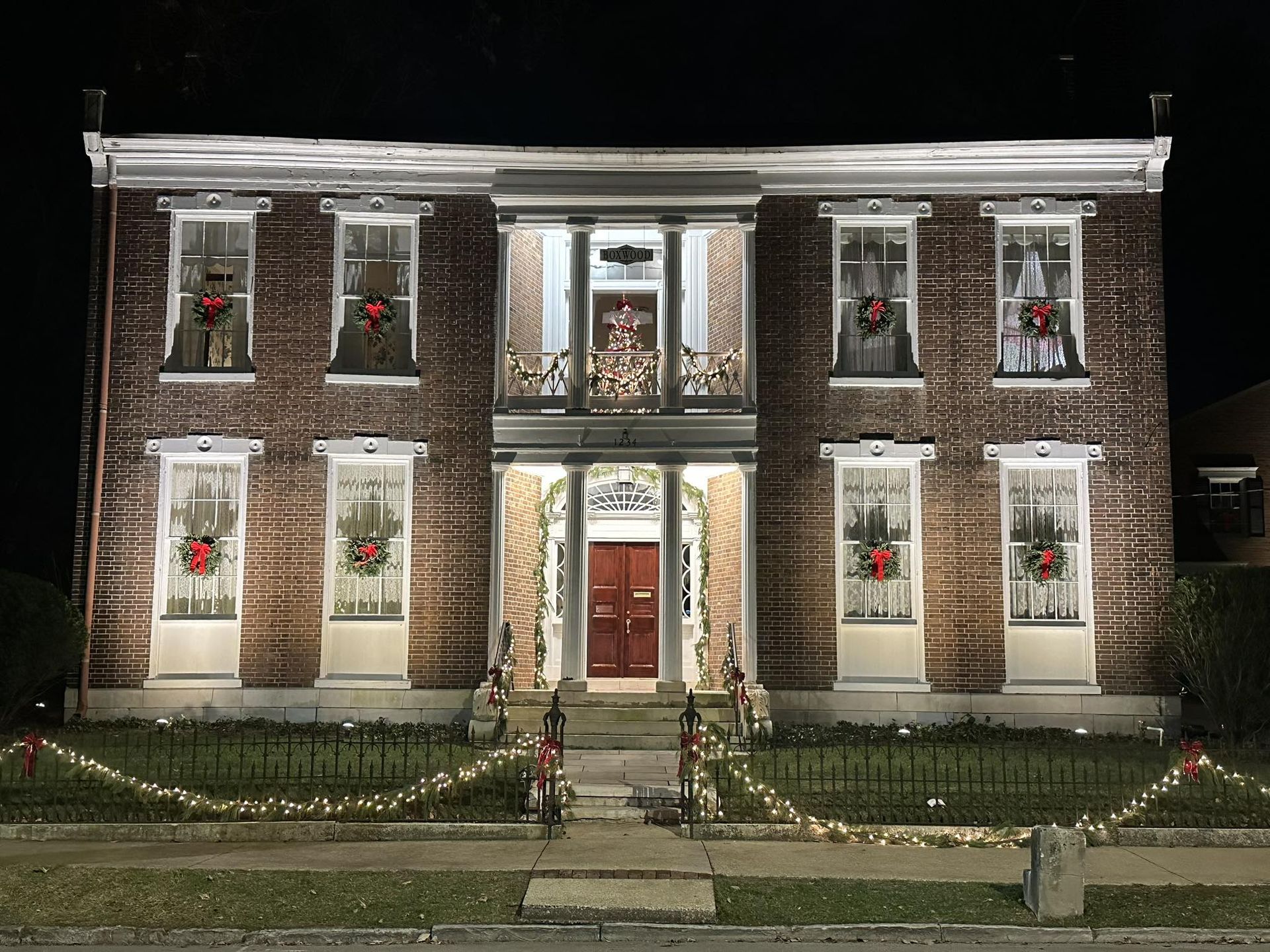
Boxwood 1843 in Bowling Green, Kentucky, is one of the region’s most important surviving examples of nineteenth-century classical architecture. Completed in 1843, it reflects a period when South Central Kentucky strongly favored Greek Revival design, particularly the Doric order. Rather than relying on size alone, Boxwood stands out for its balance, restraint, and craftsmanship– qualities that earned it the enduring nickname “The House of Dignity.”
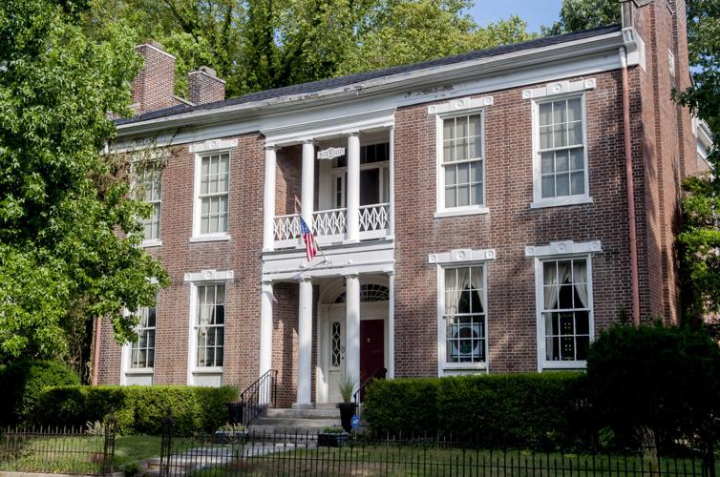
Built by J. B. Clark, with possible involvement from architect Hugh Roland, the house showcases hallmarks of the Doric style, including fluted columns and clean, understated capitals. Its recessed, loggia-style portico is especially unusual, offering a distinctive variation on the classical form. Features such as Flemish bond brickwork, carved stone elements, and complex cornices highlight the skill of the many artisans involved, including enslaved laborers whose contributions were vital but largely unrecorded.
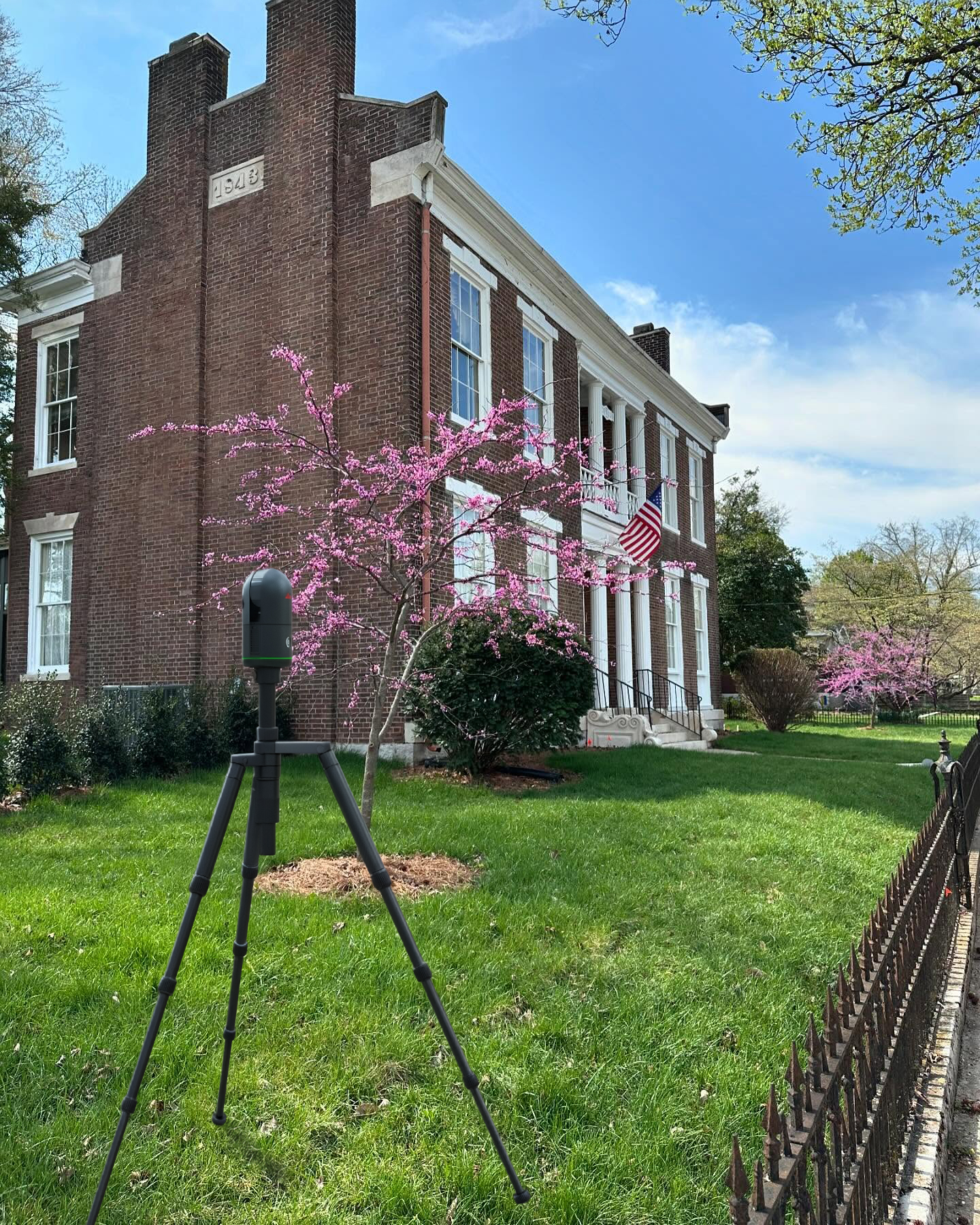
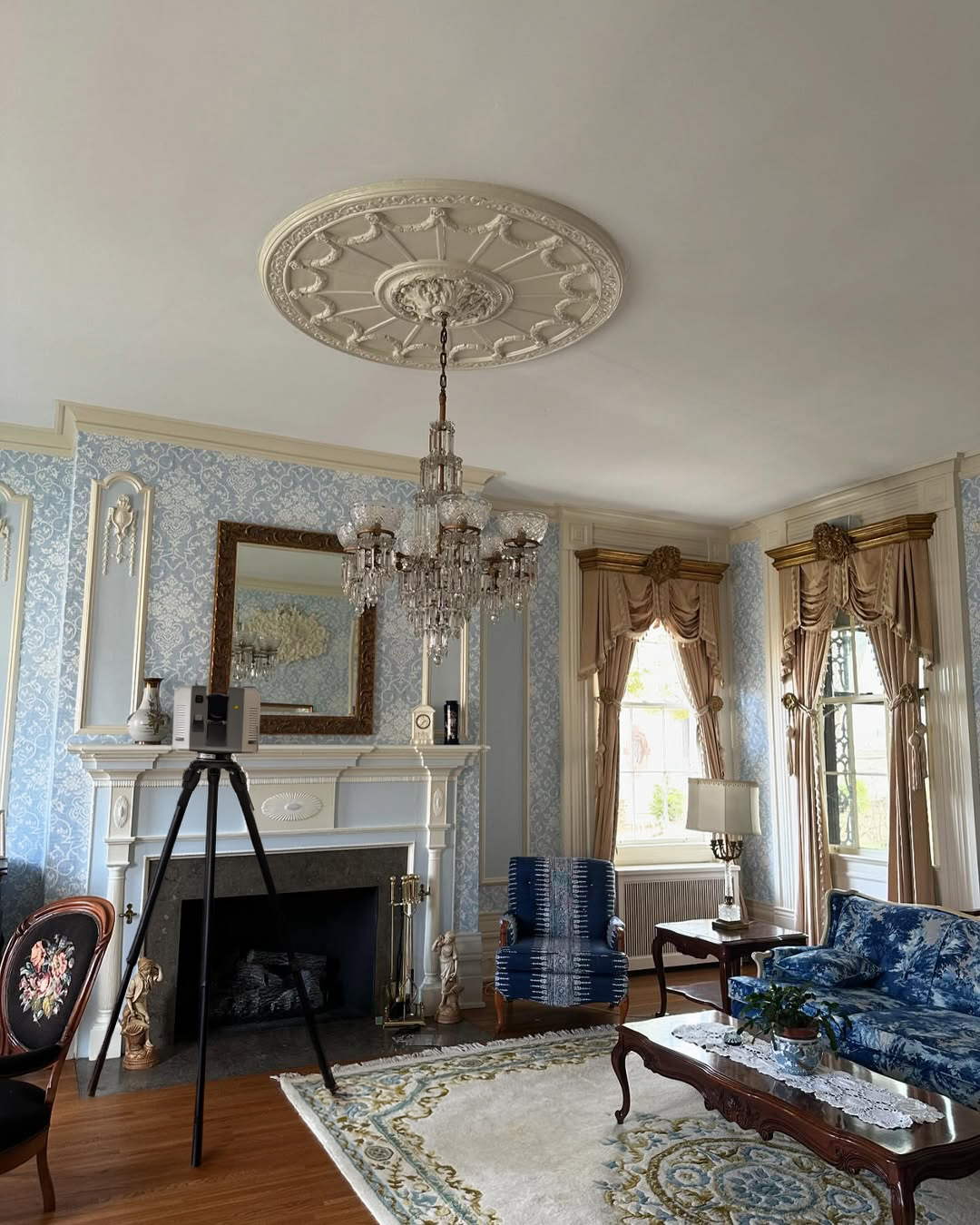
By the early twentieth century, Boxwood had begun to decline, but a careful expansion around 1930 by the O. V. Clark family ensured its survival. Working with architect James Maurice Ingram and landscape architect Ruth Rabold, they replaced the original wooden ell with a brick addition that blended seamlessly with the original structure. Today, under the stewardship of current owners Eric and Ellen Aldridge, Boxwood continues to be thoughtfully restored and preserved. In July of 2025, we had the opportunity to document the house in detail, scanning its interior with the BLK360 G2 and its exterior with the RTC360– capturing a historic landmark that remains very much alive within its community.
Best scanning practices
To document Boxwood in its current state, we approached the project with two distinct scanning workflows, one for the interior and one for the exterior, each chosen to suit the space and level of detail required. Inside the house, the BLK360 G2 proved ideal for capturing tight rooms, stair halls, and fine architectural details. Its compact size allowed us to move efficiently through the interior while still recording highly accurate geometry and high-quality HDR imagery, preserving everything from wall proportions to surface textures and decorative elements.
Interested in the BLK360 G2?
Learn more about the high accuracy laser scanner from Leica Geosystems.
For the exterior, we transitioned to the RTC360, which is better suited to larger, open environments and longer sightlines. This allowed us to capture the full massing of the house, the recessed portico, and surrounding site context quickly and cleanly, with excellent registration between scan positions. Using a combination of overlapping viewpoints and strategic placement around key architectural features ensured strong alignment and complete coverage, minimizing shadowed areas or gaps in the data.
Together, the interior and exterior datasets create a comprehensive digital record of Boxwood as it exists today. Beyond simple visualization, this combined scan serves as a valuable tool for preservation, measurement, and future restoration planning, providing a precise reference that can be revisited long after work on the house is complete. As Boxwood continues into its next chapter, this digital snapshot helps ensure that its architectural character and craftsmanship are preserved not just physically, but digitally as well.
Registering and cleaning the data
Once field capture was complete, the interior and exterior scans were brought into Leica Cyclone REGISTER 360 PLUS for processing and registration. Because the BLK360 G2 and RTC360 datasets were captured as separate projects, each was first registered independently to ensure clean alignment and internal accuracy. This approach allowed us to fine-tune registration quality for each environment before combining them, rather than forcing everything into a single dataset from the start.
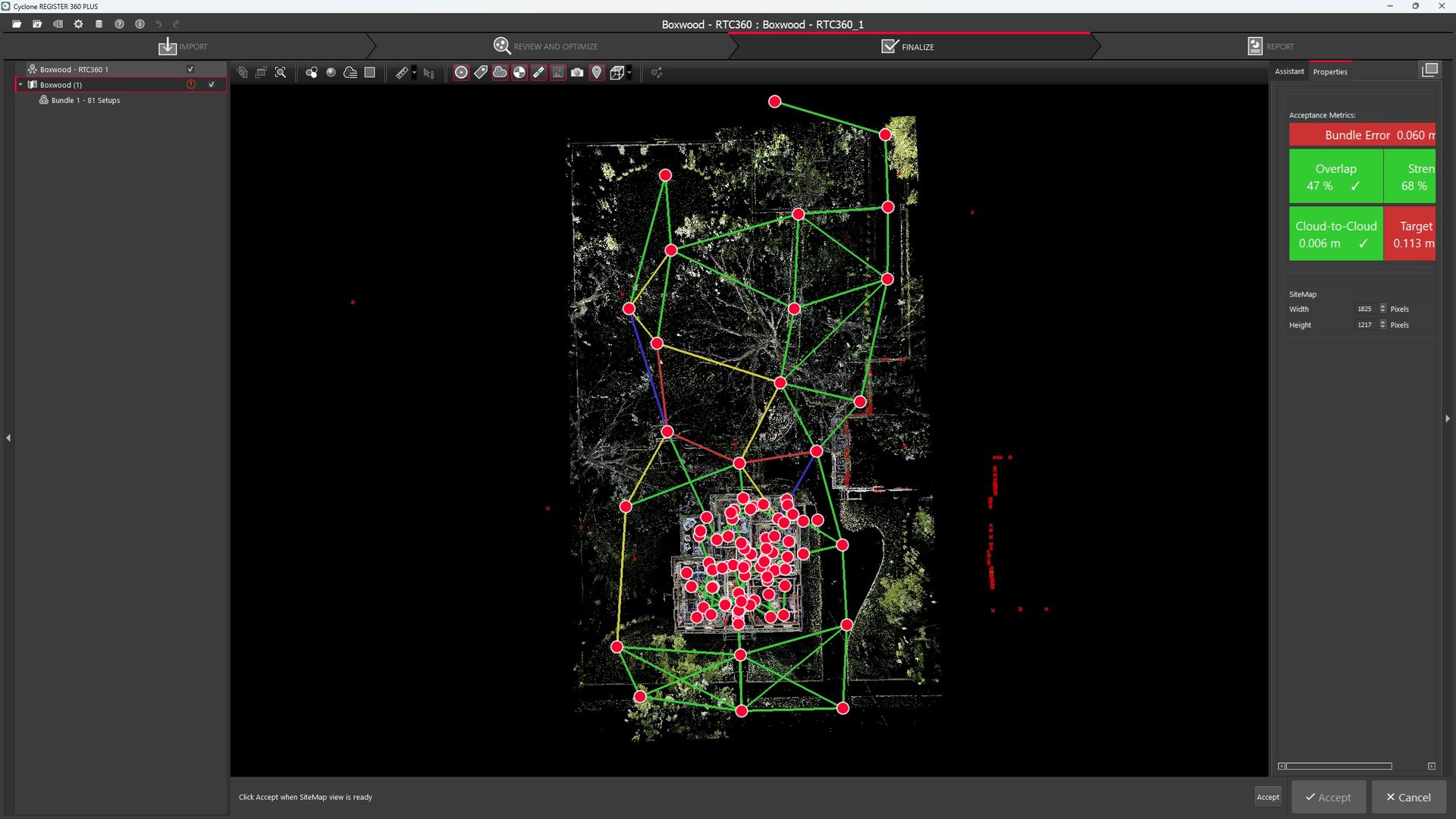
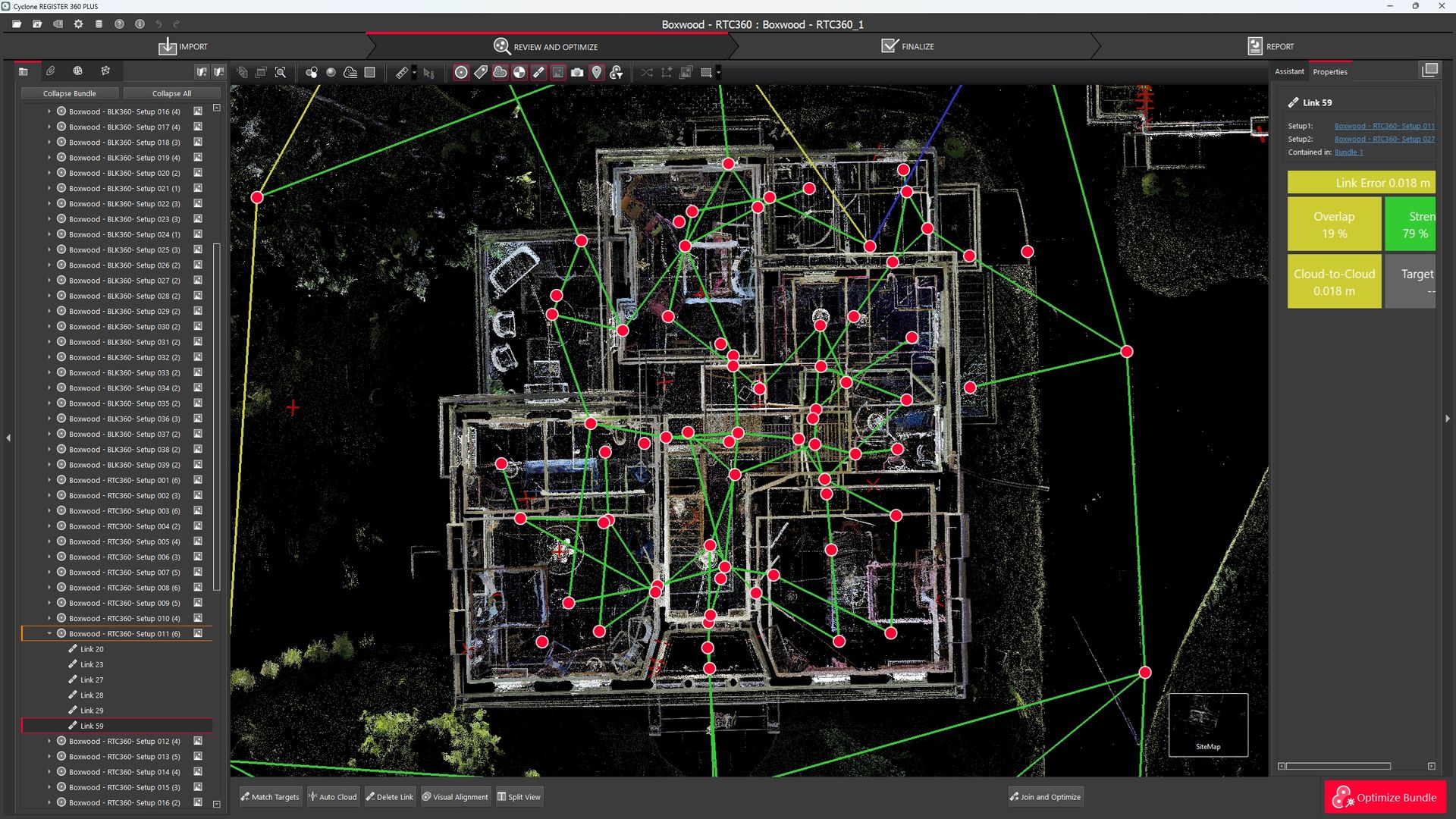
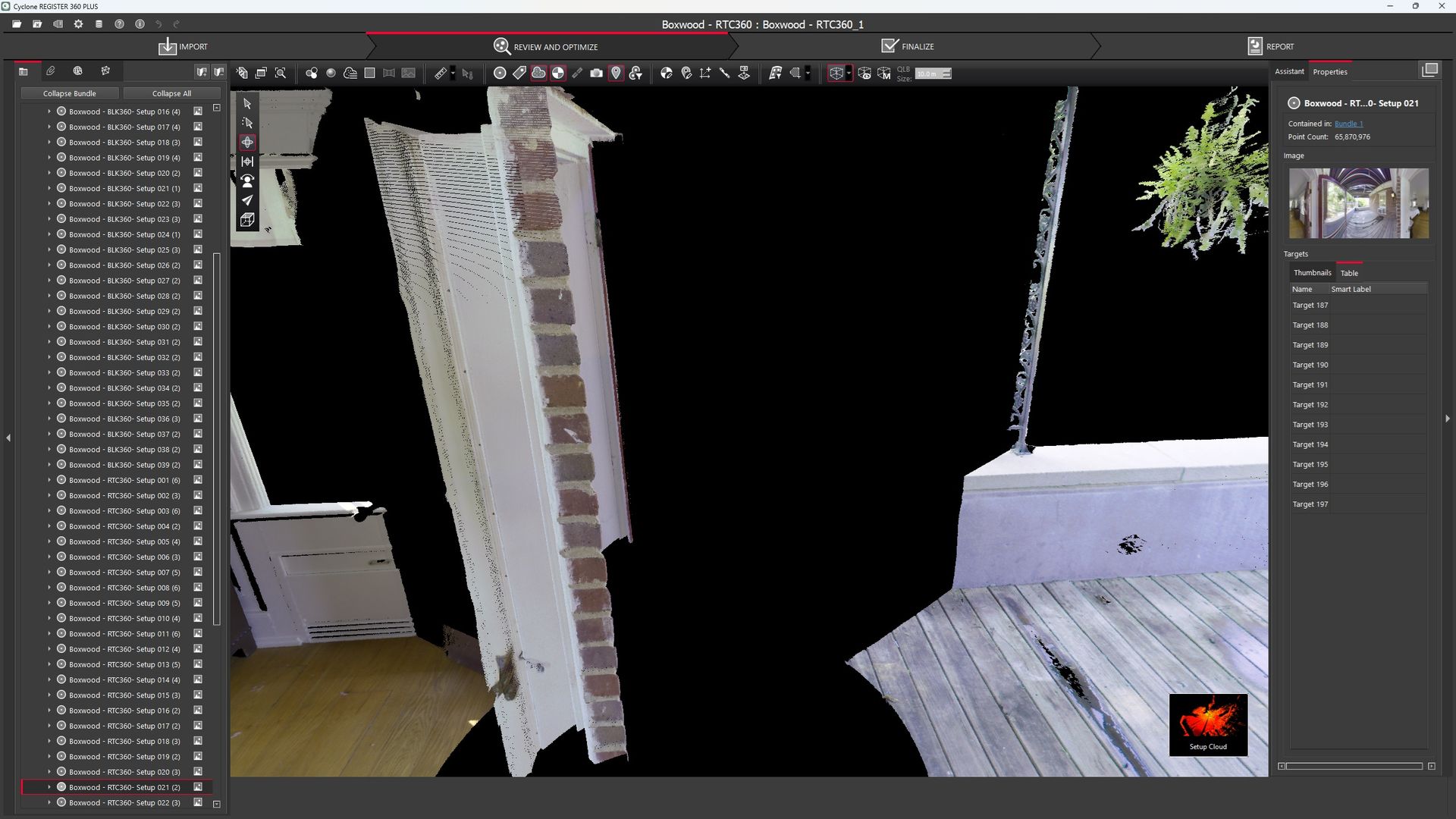
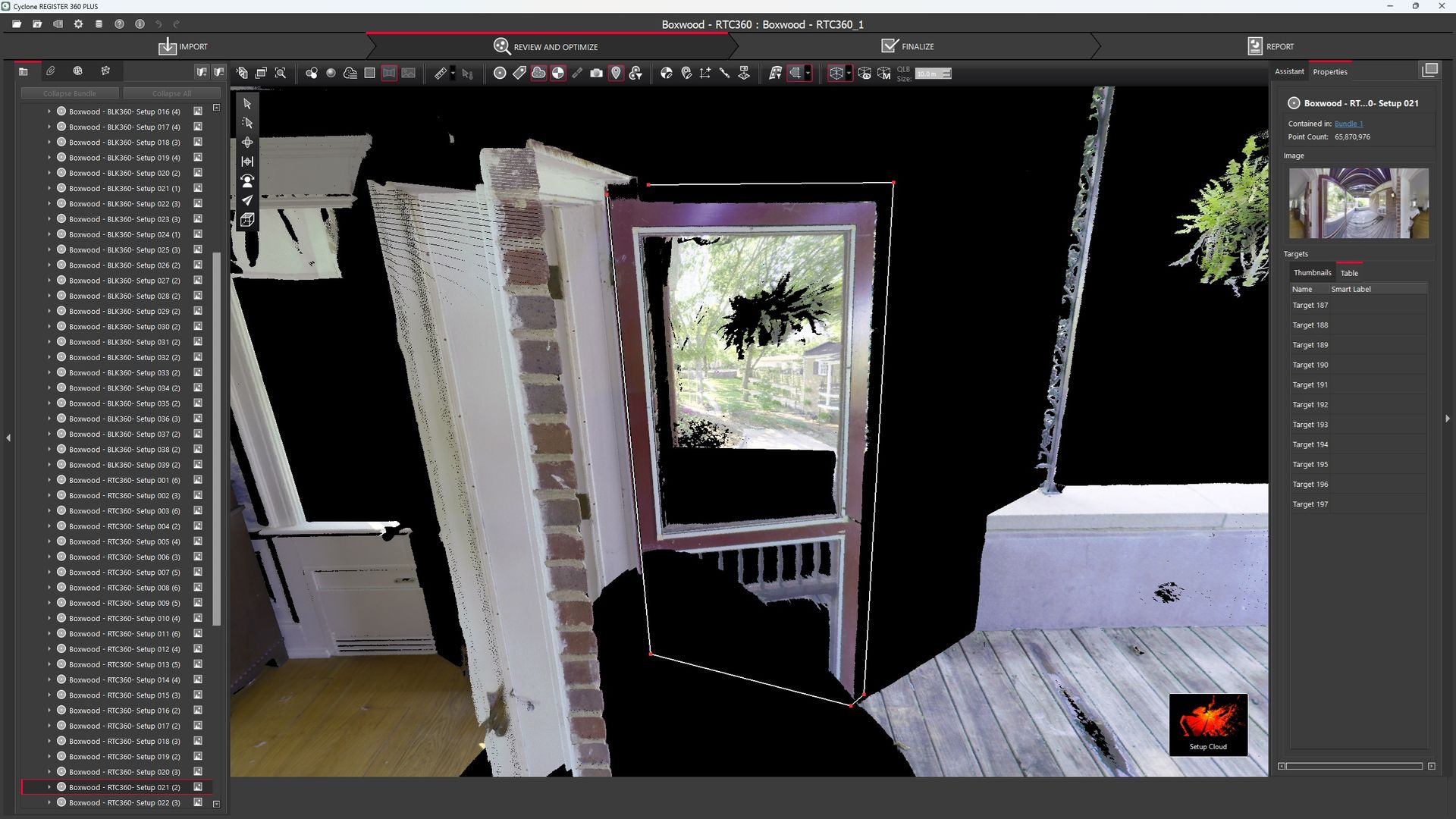
After both models were fully registered, we merged them inside the software using shared architectural reference points like doorways, window openings, and transitional spaces to stitch the interior and exterior together into a single, unified model. This step is critical when documenting historic structures, as it creates a continuous digital representation of the building rather than two isolated datasets. The result is a seamless point cloud that allows users to move naturally from outside to inside, preserving spatial relationships exactly as they exist in reality.
With the full model assembled, final cleanup and optimization focused on removing minor noise, aligning color data, and ensuring the point cloud was ready for long-term use. The finished dataset now serves as a reliable reference for measurement, restoration planning, and digital visualization. More importantly, it provides a lasting record of Boxwood at this moment in its history, one that can support future work even as the physical building continues to evolve.
Our project at Boxwood 1843 demonstrates the potential of reality capture technologies to play a meaningful role in preserving historic architecture, creating a lasting digital record that supports restoration, documentation, and future stewardship. If you’re interested in applying the same workflows to your own projects, our team is always happy to help you select the right scanning equipment and software for your needs, whether you’re working in heritage preservation, architecture, or construction. Contact us to learn more about purchasing or renting Leica reality capture solutions. And if you’d like to follow Boxwood’s ongoing restoration and see the house come to life day by day, be sure to follow Boxwood on Instagram and on Facebook, where the Aldridges regularly share updates, progress, and behind-the-scenes glimpses of this remarkable historic home.
Unsure of how to perform some of the steps mentioned in this article? Don’t worry, we’re here for you. For more information and tutorials on how to use Cyclone REGISTER 360 PLUS, check out our dedicated page our youtube channel. If you have further specific questions, we’re always happy to help. Contact us here and we’ll reach back out to you as soon as possible!